Saikano
Type: Series
Studio: Gonzo
Aired: April 2, 2002 to September 24, 2002
I've got a semi-respectable stash of anime on VHS / DVD / Blu-ray. And my collection can broadly be split into two categories: stuff I bought purposefully because I knew/assumed it'd be a series/film I'd enjoy, and stuff I bought because I stumbled upon it in the wild at my local b/s/t record store. When grabbing things at random I occasionally discover a hidden gem. But sometimes I end up with, well, with something like Saikano.
Saikano is an early 2000s 13-episode series based on a manga that began in 1999 (there's additionally a live-action adaptation that looks completely insane). It's also called Saishuuheiki Kanojo: The Last Love Song on This Little Planet (Saikano is an abbreviation, see) and She, the Ultimate Weapon. It falls into that broad category of stories about a "chosen" young woman with magical powers no one else possesses. What jumps to my mind immediately is the visual novel eden*, though that is much, much better than Saikano.
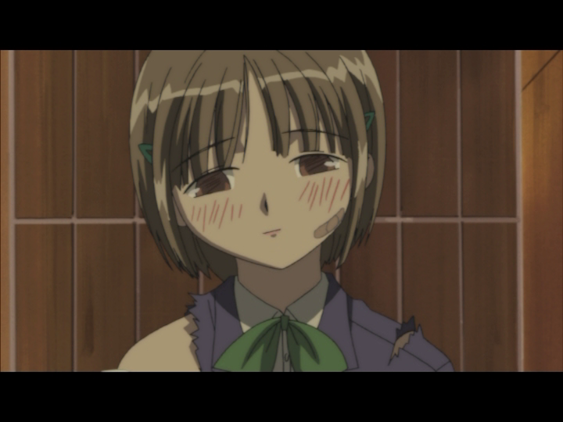
Saikano begins as your typical anime teenage love story. The 6-foot-5 gray-haired man-boy Shuji and his babyish clumsy moe gf Chise fall for each other rapidly (as in, within episode one). They're awkward but kinda cute together, and reveal their feelings via a shared diary. And they're always blushing. Actually, everyone in this story is perpetually blushing, with the blush lines sometimes poking off their faces like kitty whiskers. Everything seems cool until bombs start raining from the sky. Japan finds itself in the middle of a global conflict. All seems lost for Shuji and his pals, until Chise shows up that is. She's been transformed by the government into some all-powerful cyborg girl who can wipe out cities at will. The remainder of the series grapples with the relationship between Shuji and Chise, as she's now an instrument of death and gradually becomes "more machine than human" (of course).
The plot makes no sense. Why does the "ultimate weapon" need to be a goofy teenage girl? Why does it need to be a human at all instead of an independent device? If it has to be a human why can't it be a fit, willing man? Why aren't there multiple weapons? Who is Japan even fighting, and why? Why does Chise need to hide her weapon status from her family and continue attending school? Defenders of this shitty story (they exist) respond with "lol whatever it's just a Japanese cartoon." I'd buy this if 1) the entire series was slapstick and silly or 2) the series was clearly allegorical and spiritual to the point where the particulars don't really matter. However, Saikano tries to play it straight with this storyline, and it's a disaster.
As for the love story, it dissolves quickly. Shuji and Chise are separated for a long stretch and Chise is sent around Japan blasting shit apart. And then there's a bunch of cucking. Yeah. Shuji is slaying MILF poon for some reason (his former middle school teacher wtf) and Chise decides to "get with" what appears to be a random soldier but he's actually the husband of the woman Shuji is laying pipe to. Absolutely ridiculous. There are also these additional romance(?) scenes, like a girl who's been maimed by war confessing to Shuji on her literal deathbed followed by Shuji spilling his spaghetti and calling her beautiful and then trying to undress her while she's injured and minutes from ultimate demise. In the most technical sense, there truly isn't that much sex because whenever folks are about to "get busy" one or both parties become overly emotional and then they immediately halt. It reminds me of that scene in Deuce Bigalow (stay with me...) where the exasperated judge asks "During your entire stint as a he-whore, did you have sex with anyone?" And the war/action scenes? Mostly just a bunch of explosions and images of missiles. Okay.
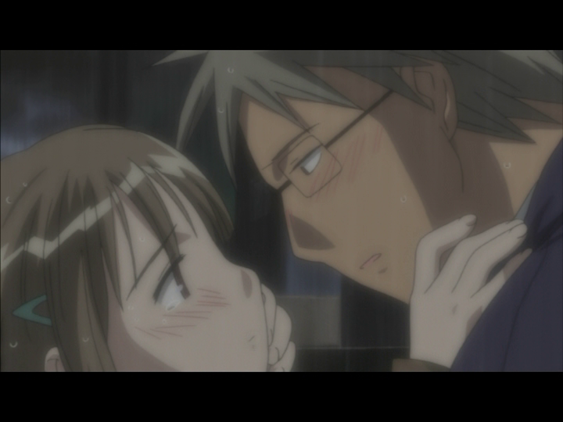
The series ending is... actually decent, in a way. It is SPOILERS revealed that the world's end is inevitable and that all human life will perish in a moment. Things get ambiguous (think of the Evangelion finale) with Shuji's ultimate fate a matter of viewer interpretation. The best visuals are all crammed into the finale too: the red apocalyptic sky and Chise's all-consuming final form. In general though, Saikano looks rather bland with derpy character designs. Music consists of the opening and closing themes, with various instrumental interpretations sprinkled throughout. I like both these tracks, especially the yearning, acoustic closing.
Saikano ultimately feels like a cheap manipulative attempt at a tearjerker that's just too preposterous to indulge in seriously. The lead characters are crying in virtually every scene, every episode. It's exhausting. And there's never a payoff. Anyone interested in 2000s "sad anime" is better off with Air or something similar.
Rating: 1.5/5
Reviewed: 02/06/26