Mother
Famicom (Patched)
Pax Softonica / Nintendo
1989
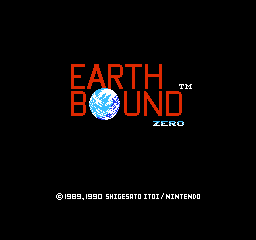
Mother on Famicom is the first game in the Mother series (o rly? ya rly). Though ostensibly a Japan-only realese in its purest physical form, those looking to play it in English won't need a translation patch, as an English prototype ROM is floating all around the interbutts. It's titled EarthBound Zero. Now, I own a Mother cart but I "patched" it with an EarthBound Zero ROM to play it on my Retron 5 console. I guess there's a modern official digital version now too, called EarthBound Beginnings.
Now, probably anyone my age who's into JRPGs didn't get to playing Mother until AFTER experiencing the (localized) SNES sequel EarthBound. It's a bit jarring, as not only is Mother the inferior game on most every single relevant metric, but it's also SO similar to EarthBound. And I don't mean "similar" in the way Dragon Quest II is similar to Dragon Quest VI or whatever. I mean, Mother and EarthBound have lead characters with almost identical designs, share enemies, share musical tracks, share environments, feature an abstract main villain that can only be defeated via "unconventional" means, share the same menus and save system, and of course a similar irreverant humor and charm. That isn't to say they're alike to the point where EarthBound feels like a "reimagining" or Mother, but the games are entwined much more than your average "part one and part two."
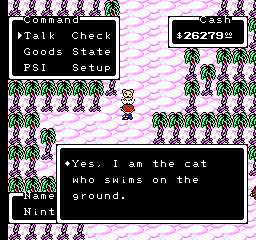
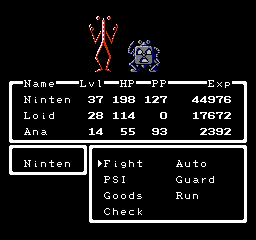
One of the most obvious oddities of Mother is that it eschews medieval fantasy and fantastical space travel in favor of a modern setting. In this case 1989 (what's presumed to be) America. And the heroes are kids. Not the typical JRPG teenagers but more literal kids. Lead protagonist is the sweet, hatted Ninten (as opposed to the EarthBound "Ness" -- get it?). He's a young man with psychic powers who awakens one day to find his household lamp on the rampage. He's soon informed by his father that the world is in crisis and that Ninten's (apparently inherited) abilities just might be of some help. Ninten's journey has him soon joining forces with Ana, a girl with psychic abilities similar to Ninten's but with more emphasis on the offensive end, and "Loid" (Lloyd), a bullied genius who lacks the mystical abilities of his friends but knows his way around rockets and flamethrowers. There's a fourth playable character named Teddy who's billed as some kind of bad ass tough guy. When Teddy joins he kicks out Loid for ostensibly being the weakest, so the party size never exceeds three. Eventually Teddy gets pwned and Loid rejoins.
As for the plot itself, it's a bit odd. More like the pacing is. The game is really a series of visits to strange locales, each with a different mystery than the last, with the overarching "story" fading into the background. That is, until the final half hour where there's a massive info dump about Ninten's relatives and a fading dream land and alien invasions and so on. But yes, the appeal of Mother simply lies in seeing what lurks around every corner. Quick summary of the game's opening acts... After battling the aformentioned lamp and bidding farewell to his mother, Ninten heads to the town of Podunk. He must buy a canary chick from the store, find the nearby canary village, and return to the chick to its mother, who breaks out in a "song" that must be acquired to finish the game. Then Ninten heads to the cemetary to battle zombies and rescue a little girl. Then there's a zoo that harbors an iconic type of robotic/supernatural enemy. Shortly after, Ninten is whisked away to the fluffy ephemeral land of Magicant, seemingly created out of one's imagination. And this all occurs before Ninten meets his buddies!
A lot of time is spent in battle. This is a turn-based JRPG, with plain black backgrounds à la Dragon Quest II and static enemy portraits. Some enemies are pretty hilarious. There's a hippie bad guy lurking around Podunk, for instance. 60s guitar rock plays during his battles and you don't hear that track ANYWHERE else in the game. Don't expect many bosses though; in the vein of Phantasy Star most Mother dungeons feel more like item retreival missions. Battles themselves are pretty rote with the expected attack, defend, psi (magic), run, check, run. There's also an auto option but I never used it, not sure how smart it is. Mashing A is a bad idea as you can whiff dead air, like in the original Final Fantasy. Ninten and Ana both have a glut of psi powers. Many affect stats of friend and foe alike, and can be exploited during certain difficult fights. Mother is very grindy and there's just no way around it. It's literally impossible to finish the game under level 25 due to a critical boss battle that can't be activated if that particular stat isn't detected. But that's still too low to survive. The final area, Mt. Itoi, was apparently untested (seriously). Even at around level 50 I still found myself utterly destroyed by certain foes. It's best to simply run from battles come a certain point, thankfully the "run" option seems to be successful enough. Outside of battle, similar primtive menus are used. Want to talk to something? Expect to press A twice. Once to bring up the menu and then again to select the actual "talk" option. And inventory space, or lack thereof, is a huge issue. Especially early on, when it's just Ninten. Certain items, like the basement key, only need to be used once and then can be stored with Ninten's sister (but how would you know?). There are arguably too many items in the game, to the point where items and "food" get seperate shops. Most are useless but perhaps worth playing around with. In contrast, there are surprisingly few options regarding weapons and equipment. The stuff sold in Magicant can probably last a player 10+ hours.
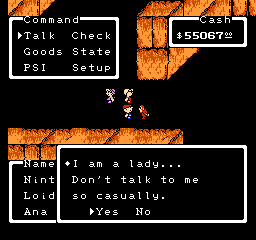
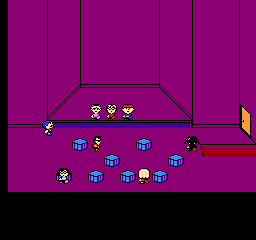
Dungeons are a thing here, of course, but the bulk of the world of Mother consists of towns and the passageways that link them. And the towns are MASSIVE. Unlike EarthBound, where excess space means lots of fun stuff to look at, the Mother towns are full of nothingness. There's actually so much dead space in the game (combine this with the tiny character sprites) that it's far too easy to get disoriented. This extends to the dungeons. One notable factory is a cold dead expanse of gray. Check a map online or prepare for hours of torture. As per the series though, it's still worth exploring to chat with every NPC. While the game isn't always laugh-out-loud funny, there are some select characters that are absolutely hilarious. Like the dog poop woman, trust me. It's also worth diving into the side quests, just to see how ridiculous they are. There's a cave of lying monkeys. A man who loses his dentures who then proceeds to FILL your inventory with mouthwash once they're returned. A man who will take your strawberry tofu and exchange it for "swear words" (a literal item to be used in battle). Ninten can get arrested for underage drinking. And of course, there's the requisite message from Shigesato Itoi, hidden deep in the desert.
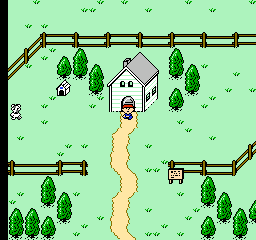
Visuals are pretty mixed. While the enemies appear to be hand-drawn and are actually quite lovely, the top-down environments are bland and cut & paste. I do appreciate the oblique projection of the overworld though; everything is "slanty" in a way that's aesthetically pleasing. Character sprites are so small and unexpressive that it makes certain pivotal scenes (unintentionally) awkward and funny, like Ana's love confession and the bar concert. Music is a series focal point, and excellent in Mother. There's an emphasis on sounding more "poppy" than traditional game music. Lots of simulated guitar and bouncy bass lines. Then there are the really "sad" nostalgic bittersweet synthy themes. The completed "eight melodies" played near the game's end is absolutely gorgeous, as is the title screen theme (reminds me of Metroid in the best way).
It's hard to deny that Mother can ultimately be a frustrating experience. As idiosyncratic as the aesthetics and storline are, the 8-bit JRPG pitfalls (excessive grinding, lack of direction) are still here in full force. Still, anyone interested in the series needs to start here. If anything, it lays the groundwork for one of the best RPGs (games) of all time.
Rating: 3.5/5
Reviewed: 11/02/25