Arcade Archives CADASH
Switch eShop (Arcade emulated)
Taito / HAMSTER
1990 2023
Arcade games and action-RPGs... two staples of Japanese gaming, it feels only natural to combine them despite their seemingly diametric nature, right? Namco's attempts came first with the likes of The Tower of Druaga and Dragon Buster (both are butt cheeks). They followed these up with The Return of Ishtar (better but crippled by mandatory co-op) and an arcade conversion of Valkyrie no Bouken (probably THE SINGLE WORST ARPG crafted by a major developer, just stunningly bad). It was Taito who finally got it right come 1990, with Cadash (which shares a name with the fantasy world contained within). A more sophisticated game in the vein of Ys III, this remains one of the best arcade titles of any stripe.
The story is kept succinct and simple. A princess is captured and the king sends forth a warrior (possibly with a companion in tow) to rescue her. Holding the princess hostage is a Balrog. Yes, straight out of the Tolkien mythos, though "Balrog" is spelled incorrectly in most versions of the game due to Japanese/English translating, an attempt to avoid flagrant copyright violations, or both. The land of Cadash is one of medieval fantasy, with the appropriate selection of heroes: a fighter, a mage, a priest(ess), and... a ninja? Well, this was developed in Japan. Naturally, all four character classes differ in various ways. The ninja's my personal favorite, and probably the best choice for beginners. He resembles a maskless Ryu from the Ninja Gaiden cut scenes, and wields projectile weapons (namely shurikens) through the entirety of the adventure. The fighter is your typical barbarian tough guy: strong attack but with a short range. The mage and priestess wield different types of magic (offensive vs. healing). They're weak(er) physical fighters for a long stretch of the game, but by the end become quite well-rounded. Magic is somewhat clunky to utilize. It requires holding down the attack button to scroll through available spells, then releasing the button once one is selected. Most importantly, the characters complement each other beautifully. While Cadash holds plenty of excitement for the lone individual, a two-player run is absolute bliss (especially with the unstoppable ninja and priestess combo).

The game's structured in an interesting fashion. There's a series of five lengthy "levels." Most have a town embedded somewhere within, or, at the very least, a shop. Levels may appear mazelike initially, but all require the character(s) take a singular direct path, with certain sections gated off until key items are obtained. Environments in Cadash also "loop" brilliantly in a circular way, eliminating any egregious backtracking. Towns contain NPCs that shockingly dispense useful advice, as well as the requisite inns and item shops. There are weapons and armor to equip, as well as healing herbs, antidotes, and time extenders. The scenery is quite striking, even if most of the journey takes place within a series of subterranean caverns. The game exudes a surprisingly "dark" (literally and figuratively) vibe, and I wouldn't blame anyone for mistaking this for a long-lost Castlevania entry. Towards the end of the game there's a twisted "death world" comprised of fire, graveyards, and floors and walls built from the bones of slain wannabe heroes. Incredible.
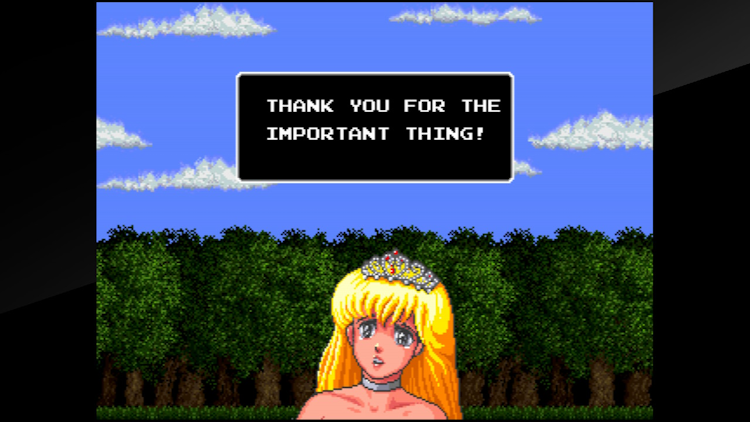
More compelling than the tired "save the princess!" narrative are the various subplots that present themselves along the way. One town must sacrifice a local to a kraken each year to remain at peace. When the hapless girl is rescued she reveals herself to be a mermaid, and begs of you not to reveal the big secret to her adoptive mother. A high cliff is unreachable, until a ladder is crafted from silk from a venomous worm. There's a town full of dwarves adjacent to a forest maze, complete with houses that are too small to enter until the hero discovers a way to shrink in size. A robber's hideout -- and the pathway to "Castle Cadash" -- can only be revealed once one figures out how to communicate with dogs. These little vignettes are tremendously charming, and prevent the game from falling into "mindless" hack and slash territory. The available dialogue is straightforward and acceptable for the most part (this isn't a particularly loquacious game), with some occasional funny lines uttered by choice NPCs. Of special note is the (in)famous final line uttered by the princess. Thank you indeed!
Controls are a touch stiff, but in a way that feels appropriate given the genre. Unexpectedly, the heroes of Cadash can slash/whip/throw in eight directions. The enemy selection is fantastic, with every sort of weird fantasy creature imaginable making an appearance: slimes, manticores, pig men, cave trolls, skeleton knights, even zombies that slowly disintegrate upon being struck. Graphics are great with plenty of detailed backgrounds and big chonky sprites (as a consolecel it's easy to forget how stunning arcade games looked in 1990). The character designs are quite charming, and the heroes sport various looks as new armor is obtained. Even the NPCs are memorable, with all sorts of distinct outfits. The ladies of Cadash are super adorable, despite the limited facial graphics. And, yes, this is one of those games with uncensored pixel boobs. The soundtrack is alright. The laid-back pieces played during those moments of rest and relaxation are best. Meanwhile, the more upbeat action tunes are peppy enough but not especially memorable.

As an "arcade RPG" there are some odd little quirks one should prepare for. First off, while there is an experience/leveling system, power leveling is ostensibly prevented by time limits. Once the timer hits zero, an invincible ghost appears and a life (one per credit) is lost, regardless of health bar status. This is a problem... or, it would be in an actual arcade. Here on the Arcade Archives there are unlimited (virtual) quarters, and full respawn continues. Of course, with that in mind there's also no need to level up in the first place! Items are activated automatically, which feels a bit strange. The healing herbs only restore 10 HP which is basically nothing, especially 50+% of the way into the game. Any "complaints" I have about the game are additionally small little oddities. Attacking NPCs to converse is really weird. The knock-back upon being hit can get annoying, especially when it comes to being submerged in water or lava as it just creates an HP-drain loop. Difficulty is also an issue. Eventually there are so many enemies it's more prudent to simply brute force one's way through via credit-feeding, as opposed to playing "properly."
Far from just being an arcade gem, Cadash is one of the better side-scrolling Japanese ARPGs in any respect. Up there with Exile and the aforementioned Ys III. "Regular" platformer and Metroidvania fans should be into this too, as it can be played straight and shouldn't take any longer than 90 minutes. Recommended.
Rating: 4.5/5
Reviewed: 01/09/25


Cadash
TurboGrafx-16
Taito / Working Designs
1991
Cadash was actually ported to two 16-bit systems back in 91/92... but it's not the usual SNES/Genesis duo. While Cadash did grace Sega's machine, its first console appearance was for the venerable TurboGrafx-16. This is an early Working Designs localization, before they turned their attention to CD-ROMs and cheesy voice acting (Working Designs also localized the TG16 Parasol Stars). The script isn't as "jokey" as what you'd see in later WD stuff. The final boss does make a Carl Sagan joke(?), though, for some reason.
This is a faithful port in many ways, with all key environments and enemies included. Two-player cooperative play is implemented splendidly. The visual design has been altered significantly. Everything's brighter and softer, almost velvety looking. Certain dungeons have been modified, with the arcade's long seamless stretches now divided up into smaller rooms. Mechanics are basically identical, and yes you still have to whip or stab someone to speak to them. Poor NPCs.


The biggest alteration made involves lives (or lack thereof) and difficulty. Credit-feeding is (obviously) no longer possible. And the game must be beaten on a SINGLE life. Seriously. This sounds worse than it actually is. First of all, the time limit / ghost dynamic has been scrapped, so it's possible (necessary) to power-level early on. Healing items can be hoarded, including elixirs that replenish all HP, and they're once again activated automatically. In two-player mode, a dead party member can be revived at an inn. Plus, there simply aren't as many onscreen enemies, and the arcade "cheapness" is absent. That said, there's no room to "mess around" here, so tread lightly.
A fine conversion overall; any and all changes feel like they were made out of necessity.
Rating: 4/5
Reviewed: 01/10/26


Cadash
Genesis
Cyclone System / Taito
1992
Third and final version of Cadash, for Sega Genesis. This one was released in the US and Korea, but not Japan for some reason. Big immediate difference: there are only two playable characters, the fighter and the mage. That means the one girl character is toast as well as my buddy the ninja. Bummer!!! There's still co-op, thankfully. I played with the fighter. As screenshots indicate, the visuals are closer to that of the arcade original (right down to the same portrait of the princess in the ending). Music is weakest here though, downright annoying in parts. There's some cut content. The giant kelp (yup, kelp) boss is totally excised.


As with Exile, Working Designs handled the TurboGrafx port but not the Genesis version. So, the dialogue is back to being straightforward and "normal." Some odd difficulty in this one. You can buy more healing items in shops, but the game is way more grindy overall. Maybe (probably) I just suck, but I spent about an hour total grinding, which is a big ask for a game designed to be played in one sitting. Technically, this is the "worst" version of Cadash overall, but just barely. Narrowing focus to just the Genesis library, it's an absolute gem.
Rating: 4/5
Reviewed: 01/11/26
